How the Bitcoin Price Is Formed — and Why It Moves So Much
12 Sept 2026 · 9 min read
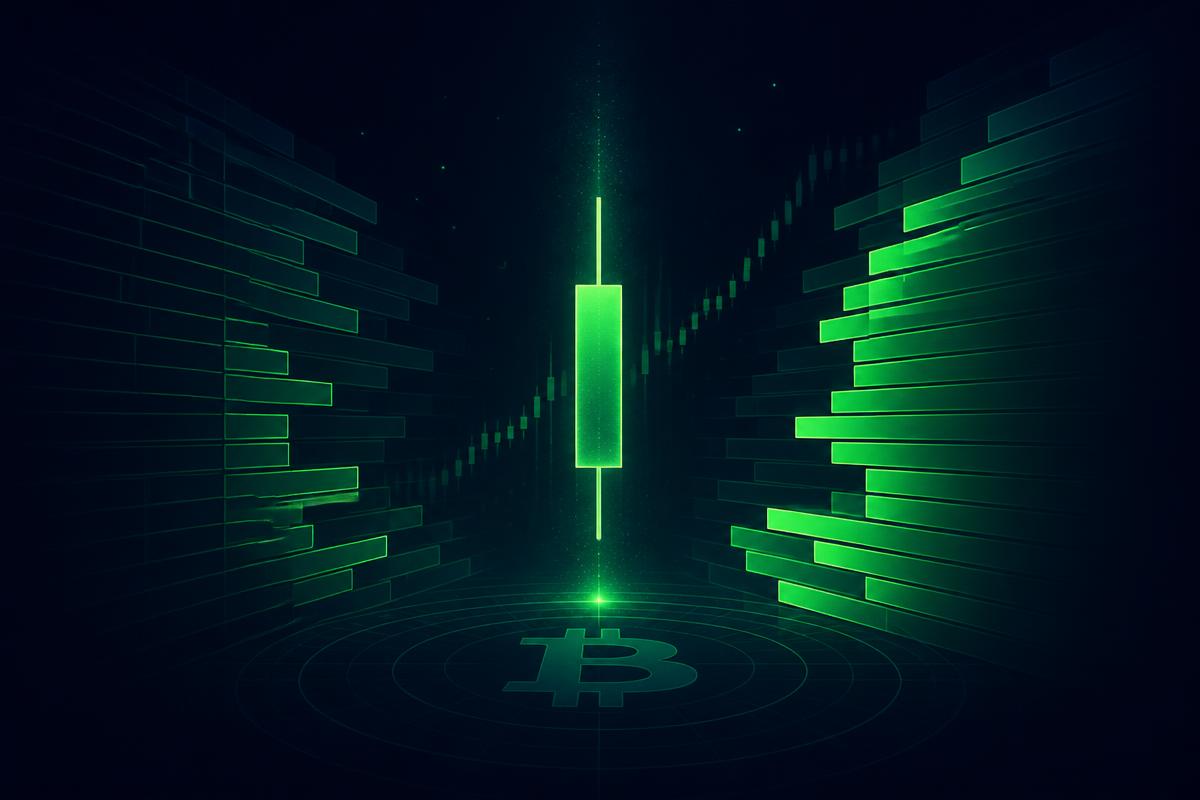
There is no committee setting the Bitcoin price. It is the last trade in a global order book — and once you can picture that book, the violent swings, the thin weekends and the liquidation cascades all start to make sense.
When you look up the Bitcoin price today, you are not reading a valuation produced by an institution. You are reading the price of the most recent trade between two strangers on one particular venue. Every exchange has its own order book, its own participants and its own slightly different number, and the figure shown on price sites is usually a volume-weighted average of several of them.
An order book is simply two lists. On one side, buyers post the price they are willing to pay and how much they want. On the other, sellers post what they will accept. When the highest bid meets the lowest ask, a trade happens and the price updates. Nothing more mystical than that is going on, which is why the price can change hundreds of times a minute without any news at all.
Liquidity is the depth of those lists, and it explains most of the volatility that surprises newcomers. If there are large orders stacked closely together, a big buy barely moves the price. If the book is thin — as it usually is at weekends, at night, and in smaller coins — the same buy eats through several price levels at once and the chart prints a sudden spike. Nothing changed about Bitcoin itself; the queue was just short.
Leverage amplifies all of it. Traders borrow to take positions far larger than their deposits, and the exchange closes those positions automatically when the collateral runs out. A modest drop can therefore trigger forced selling, which pushes the price lower, which triggers more forced selling. That is a liquidation cascade, and it is why Bitcoin sometimes falls ten per cent in twenty minutes with no headline attached.
On slower timescales, flows matter more than mechanics. Spot exchange-traded products let pension accounts and advisers buy through ordinary brokerages, and their steady daily buying or selling shows up in the price over weeks rather than seconds. Interest rates matter too: when safe cash pays well, speculative assets compete for money against a real alternative, and risk appetite tends to shrink.
Supply has its own slow rhythm. Miners receive newly issued bitcoin and sell much of it to pay electricity bills, so they are structural sellers. Every four years or so the halving cuts that issuance in half, reducing the steady sell pressure. Halvings are widely anticipated, which means markets have had years to price them in — the historical pattern of strength afterwards is real, but four examples is not a law of nature.
Finally, sentiment does real work. Crypto trades continuously, is heavily retail-driven, and reacts to regulation, exchange failures, hacks and large-holder movements. A wallet transfer of a few thousand coins can move the price purely because people interpret it as intent to sell, whether or not that is true.
What to do with all of this as a beginner: expect the number to be noisy rather than informative, avoid checking it hourly, place limit orders rather than market orders when you can, and treat any single price you see as an approximation. Understanding how the price forms will not tell you where it is going. It will stop you reading meaning into moves that were simply a thin order book on a Sunday morning.
Key takeaways
- The price is just the last trade in an order book — every venue differs slightly.
- Thin liquidity, especially at weekends, explains many sudden spikes.
- Leverage turns modest drops into liquidation cascades.
- Use limit orders and treat any single quoted price as an approximation.
Disclaimer: This article is educational content, not financial advice. Crypto assets are highly volatile and you can lose everything you put in.
Related reading

Bitcoin and Inflation: What the Evidence Actually Shows
Bitcoin is often sold as digital gold and protection against inflation. The scarcity argument is genuinely interesting; the track record is shorter and messier than the slogan suggests. Here is the honest version of both sides.
10 Sept 2026 · 8 min read
Buying Bitcoin Gradually: How Dollar-Cost Averaging Works
Dollar-cost averaging removes the question nobody can answer — whether today is a good price. Here is how to set it up, what it really costs in fees, when it underperforms a lump sum, and how to decide in advance when to stop.
4 Sept 2026 · 8 min read

Bitcoin Explained for Beginners: How It Works and How to Buy Bitcoin Safely
A jargon-free walkthrough of how Bitcoin records ownership, why its supply is capped, what mining and halvings really change, how custody works, and the risks that catch newcomers out in their first year.
2 Sept 2026 · 11 min read